
Today, I want to write about the way in which Englishness is portrayed in The Murder of Roger Ackroyd. But I want to get there by a circuitous route. I don’t want to start with the novel itself, but with a famous scene from the long-running sitcom Dad’s Army. (You can see it on Youtube here). In this scene, the eponymous platoon of the Home Guard (the aging Dad’s Army of the show’s title) are charged with overseeing the internment of a group of German P.O.W.s. The scene begins with Captain Mainwaring, part-time platoon commander and full-time bank manager, dismissing the Germans as a ‘nation of automatons led by a lunatic who looks like Charlie Chaplin.’ The affronted German naval officer, whose confidence is apparently undented by his capture, responds by brandishing a notepad and a pencil. ‘I am making notes, Captain’, he says. ‘And your name will go on the list. And when we win the war, you will be brought to account.’
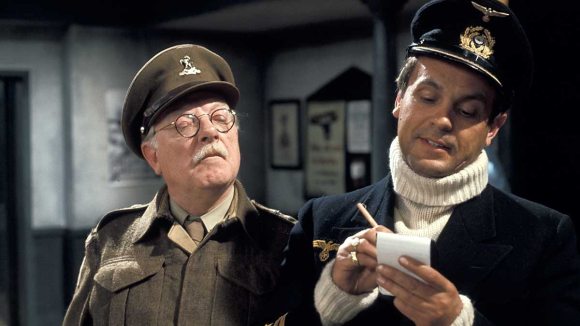
I don’t want to describe the scene in full, and I definitely don’t want to spoil the punchline for you. Instead, I want to think about the way in which the German naval officer is used as a foil: not just for Mainwaring, but for the English nation that the Home Guard metonymically represent.
The German officer – played by a younger, taller, and leaner actor than the aging Arthur Lowe – is characterised as threateningly efficient and – ultimately, self-defeatingly – arrogant and conceited. Unable to wage war by other means, the German officer wields a pencil rather than a weapon. In doing so, however, he unconsciously confirms the national stereotype he is outraged by. This representative of a nation of ‘automatons’ immediately and unthinkingly resorts to list-making, an action that is echoed in the repetitive, anaphoric ‘ands’ which begin each of his clipped sentences. Each of these sentences give rise to the next, in a chain of consequences which – for him – end in a logically inevitable German victory. The indiscriminate ‘accounting’ of information is less a substitute for warfare, here, than a continuation of it by other means.
Of course, the show suggests that this strategy is doomed to failure. As efficient as the German officer is, the information he gathers is patently useless. Despite – or perhaps because of – Mainwaring’s best efforts, his platoon remain a hapless assortment of individuals, whose differences are exacerbated by contrasting accents, appearances, social backgrounds and acting styles. On one level, they are clearly overmatched by the collective professionalism of the German military; on another, their individual incompetence is also an effective defence against it. Taking their names – as the end of the scene makes clear – is a pointless endeavour. The German officer merely succeeds in drawing up a list of men who are impervious to the form of authoritarianism he embodies.
Significantly, perhaps, the officer’s desire to discipline Mainwaring highlights the similarities between them; in expressing his expectation that the Home Guard will be ‘brought to account’, the officer borrows the economic vocabulary of the bank manager. However, if the metaphor underscores the professional efficiency of the German naval officer, it also emphasises the amateurishness of Mainwaring. Acting as an ironic reminder that soldiering is not, after-all, Mainwaring’s day-job, it casts his own captaincy as a kind of harmless hobby.
The scene therefore seems to affirm a set of toxic national stereotypes that, as any football fan will tell you, remain central to the idea of Englishness. On the one hand, the Germans are represented as an efficient, serious, professional and well-drilled collective; on the other, the English are hapless underdogs. Yet this contrast also allows the Germans to be cast as humourless ‘automatons’, who unthinkingly follow the orders of a ‘lunatic who looks like Charlie Chaplin.’ Mainwaring’s platoon may be inept, but their failings also emphasise an entrenched love of individual liberty. In this scene, Englishness is characterised by the kind of unruly individualism that, more recently, has been channelled by populist politicians, anxious to present the European Union as an authoritarian threat to the character of the nation itself.
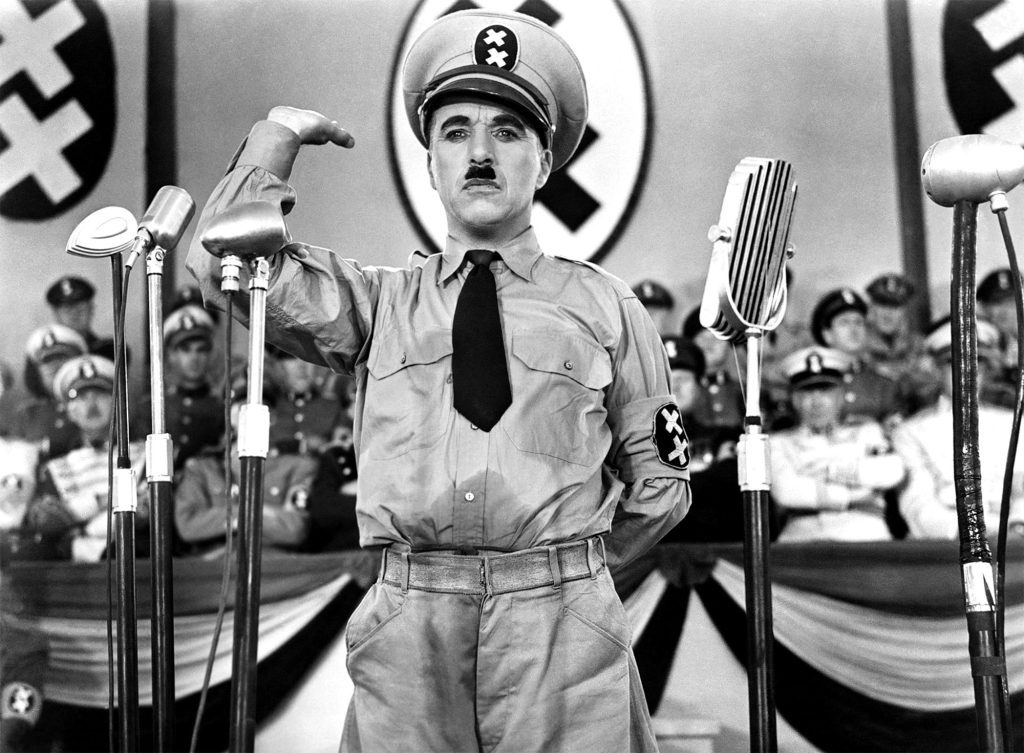
Ultimately, the scene appears to endorse Mainwaring’s initial, derogatory assessment of Germany. Mainwaring’s insult alludes to the way in which Chaplin’s 1940 film The Great Dictator satirises Adolf Hitler, puncturing the over-inflated ego of ‘the swaggering officer type’ by using his own humourlessness to reduce him, paradoxically, to a figure of fun.
Written the year after the release of The Great Dictator, George Orwell’s essay The Lion and the Unicorn characterises this irreverent attitude to authoritarianism as an essentially English trait. Against the backdrop of threatened invasion, Orwell explains that, ‘like all other modern peoples, the English are in the process of being numbered, labelled, conscripted, “co-ordinated”. But the pull of their impulses is in the other direction, and the kind of regimentation that can be imposed on them will be modified in consequence.’ In Orwell’s view, the English were temperamentally resistant to the authoritarianism of the Nazi state. Although the English might lose the military conflict, England itself would remain a society in which there could be ‘No party rallies, no Youth Movements, no coloured shirts, no Jew-baiting or ‘spontaneous’ demonstrations. No Gestapo either, in all probability.’
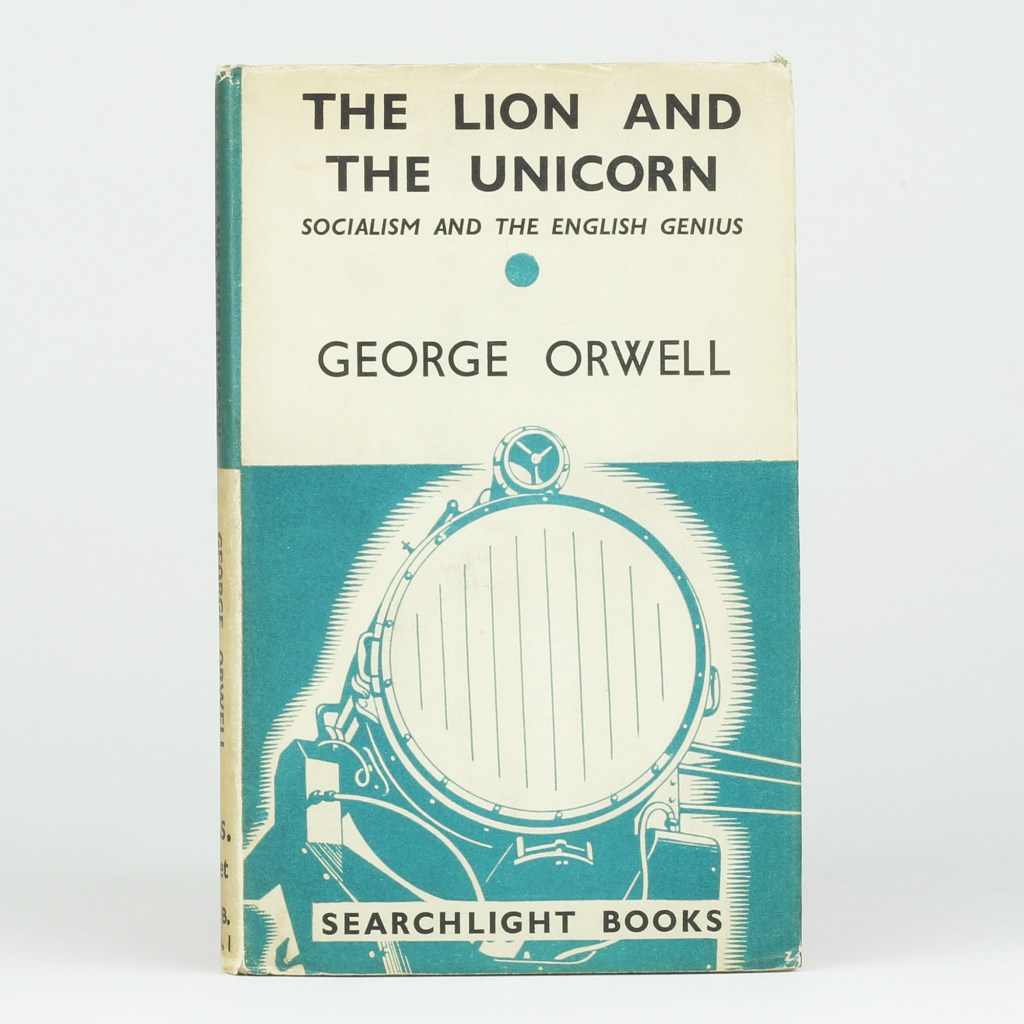
This idea of Englishness is relevant, here, because it is also central to The Murder of Roger Ackroyd. Although Christie’s novel was published more than a decade before The Lion and the Unicorn, Orwell’s description of a characteristically English ‘addiction to hobbies and spare-time occupations’ could be drawn directly from its pages. For Orwell, these hobbies emphasise the private and irredeemably individualistic nature of English life: as he notes, ‘We are a nation of flower-lovers, but also a nation of stamp-collectors, pigeon-fanciers, amateur carpenters, coupon-snippers, darts-players, crossword-puzzle fans. All the culture that is truly native centres around things which even when they are communal are not official – the pub, the football match, the back garden, the fireside and the “nice cup of tea.”’ For Orwell, these activities underscore the same national characteristics that would later be celebrated by Dad’s Army; in each instance, Englishness is defined by individuality, informality, and an irreverent attitude to displays of power. (Arguably, this form of national self-presentation has also provided the template for both the mythologisation of Paul Gascoigne and the political rise of Boris Johnson).


Christie’s novels have done more to popularise this version of Englishness than those of almost any other author. Orwell’s catalogue of English ‘hobbies’ could easily function as a summary of daily life in King’s Abbot. Although Dr James Sheppard claims that ‘our hobbies and recreations can be summed up in one word – “gossip,”’ he neglects to mention the other activities that provide an occasion for this pastime. In almost every chapter of The Murder of Roger Ackroyd, Christie’s characters are pictured drinking tea, making jam, visiting the pub, playing games and – in Sheppard’s case – pottering suspiciously in a shed. Memorably, Christie’s Belgian detective, Hercule Poirot, is first glimpsed through Sheppard’s garden fence, having attempted to integrate himself into this English idyll by growing ‘vegetable marrows’. Think, too, of the neighbourly game of Mah Jong that occurs almost half-way through the novel, in which the structural patterning of Christie’s dialogue at first replicates the formalised turn-taking of game-play, before spinning, chaotically, out of control.
“Shall we begin?” said Caroline.
We sat around the table. For some five minutes there was complete silence, owing to the fact that there is tremendous secret competition amongst us to see who can build their wall the quickest.
“Go on, James,” said Caroline at last. “You’re East Wind.”
I discarded a tile. A round or two proceeded, broken by the monotonous remarks of “Three Bamboos,” “Two Circles,” “Pung,” and frequently from Miss Gannett “Unpung,” owing to that lady’s habit of too hastily claiming tiles to which she had no right.
“I saw Flora Ackroyd this morning,” said Miss Gannett. “Pung – no – Unpung. I made a mistake.”
“Four Circles,” said Caroline. “Where did you see her?”
“She didn’t see me,” said Miss Gannett, with that tremendous significance only to be met with in small villages.
“Ah!” said Caroline interestedly. “Chow.”
“I believe,” said Miss Gannett, temporarily diverted, “that it’s the right thing nowadays to say “Chee” not “Chow”.”
“Nonsense,” said Caroline. “I have always said “Chow”.”
“In the Shanghai Club,” said Colonel Carter, “they say “Chow”.” Miss Gannett retired, crushed.
At least initially, the stichomythic dialogue proceeds according to the rules of the game itself, with each speaker’s turn to gossip neatly coinciding with their turn to play. Nevertheless, the spirit of ‘secret competition’ – which animates both the exchange of tiles and the exchange of gossip – pushes against these formal constraints, with increasingly comic results. For Miss Gannett, especially, the complex rules of Mah Jong have been only partly internalised. These highly formalised rules are represented as an exotic novelty – as references to ‘the Shanghai club’ emphasise – and they therefore seem fundamentally alien to this group of English men and women. The unruly individualism of Miss Gannett, evident in her ‘habit of too hastily claiming tiles to which she had no right’, is in contrast coded as innately English.
The figure of Miss Gannett suggests that, for Christie, as for Orwell, this form of Englishness is not unambiguously positive. Whilst Orwell presents this aspect of the English national character as a bulwark against totalitarianism, it is also an impediment to a form of socialism that emphasised the shared interests of an international working class. In reference to the Spanish Civil War, which Orwell had participated in, he notes that ‘for two and a half years [the British working class] watched their comrades in Spain slowly strangled, and never aided them by even a single strike.’ Orwell emphasises, too, the way in which the myth of the English underdog has helped to disguise their own imperial conquests – that Gannett-like habit of claiming foreign territories to which the British Empire also had no right. In this view, Miss Gannett’s comic inability to play Mah Jong disguises the networks of power which have brought the game, via Colonel Carter’s unexplained stay in Shanghai, to the heart of the English countryside.
For Christie, in contrast, the problematic nature of this form of Englishness arguably lies in the challenge it presents to the cohesion of an individual community. When Christie’s characters go to The Three Boars, potter in their shed, or make jam for a neighbour, they invariably have a hidden motive. In this novel, what Orwell describes as ‘the privateness of English life’ casts a dark shadow, which hides a variety of moral indiscretions. Ralph goes to the pub because he is hiding a secret relationship from his step-father. Caroline makes jam because she wants to exchange it for gossip. Sheppard modifies a Dictaphone in his shed in order to provide himself with an alibi for murder. In this novel individualism, at its most extreme, transgresses the written and unwritten laws that maintain social order. Sheppard’s excessive individualism is, literally, criminal.
At the same time, this criminality is arrayed against a series of stock figures who – like so many Captain Mainwarings – attempt to impose order upon this potentially anarchic form of individualism. At a number of moments, Poirot’s investigation brings him face to face with the institutional representatives of the British state, and therefore with the threateningly oppressive forms of power wielded by them. Oblique reminders of this power – even if it remains largely veiled by Sheppard’s wry commentary – are scattered throughout the text, in the persons of the innumerable ‘retired military officers’ and police detectives who appear, unbidden, at successive stages of the investigation. (It is one such figure – the otherwise anonymous Colonel Carter – who fleetingly restores order to the game of Mah Jong.)
The danger of an excessive individualism is that it will conjure up, as a necessary corrective, an equally excessive form of institutional power. In The Murder of Roger Ackroyd, the representatives of this power remain largely faceless and – like Mainwaring – comically ineffective. Nevertheless, spectral traces of it can perhaps be found within the background of the text and, particularly, within its ending.
At the time of the novel’s publication, as Orwell would later point out, people in England were still ‘hanged by the neck and flogged with the cat o’ nine tails’ – a practice which, he acknowledges, remains at odds with a more general aversion to such naked displays of power. In The Murder of Roger Ackroyd it is the Belgian Poirot who is finally able to reconcile this tension by interceding between Sheppard and the official representatives of the criminal justice system. In order to elicit Sheppard’s confession, Poirot informs him that ‘there is only one way out, and that way does not lead to freedom.’ Nor, however, does it lead to the total loss of individual liberty that would be imposed by the state. Instead, Poirot’s role as a private detective enables him to present the truth of Sheppard’s guilt to Inspector Raglan ‘in the morning,’ rather than right away. Like Sheppard himself, Poirot manipulates time, opening up space in the narrative for a climactic ‘apologia.’ Sheppard is, literally, allowed to write his own ending, finishing his confessional text at the same moment that he administers a form of ‘poetic justice’ to himself. ‘So let it be veronal,’ Sheppard declares, before killing himself with the same poison he used to kill Mrs Ferrars. In doing so, Sheppard both circumvents, and fulfils, the punishment demanded by the justice system. He maintains his liberty and, simultaneously, submits to the rule of justice – even as he concludes by wishing ‘Hercule Poirot had never retired from work and come here to grow vegetable marrows.’ Sheppard’s last words suggest that it is Poirot’s understanding of the privateness of English life which, ultimately, accounts for his ability to reconcile it with the contradictory demands of social order.
Christie’s novels have themselves been dismissed as a kind of hobby or pastime, which ‘rank somewhere between smoking and crossword puzzles.’ Yet this assessment overlooks the way in which The Murder of Roger Ackroyd skilfully dramatises the tensions that beset English society in the interwar period. Drawing parallels between Christie’s novel and the game of Mah Jong that is literally and symbolically central to it does not diminish the text; instead, it highlights the way in which Christie negotiates a series of social upheavals which are likewise central to the canonical texts of high modernism. Like the game of Mah Jong, the novel is itself structured according to a rigid set of rules that, nonetheless, Christie virtuosically transcends. In doing so she engages, on a self-consciously formal level, with the nascent liberalisation of inter-war society, on the one hand, and oppressive reminders of a militaristic state, on the other.
 Spot Lit